
Filling, Overlay or Crown - Which Is Best for Your Tooth?
Filling, Overlay or Crown - Which Is Best for Your Tooth?
When a tooth is damaged by decay, fracture, or wear, restoring it does not always mean simply placing a filling. Depending on how much healthy tooth structure remains, a larger and more durable restoration, such as an overlay or a crown, may be necessary.
But what is the difference between them? When is a filling enough, and when is it better to choose another option?
Let’s look at the advantages, disadvantages, and indications for each of these three treatment approaches.
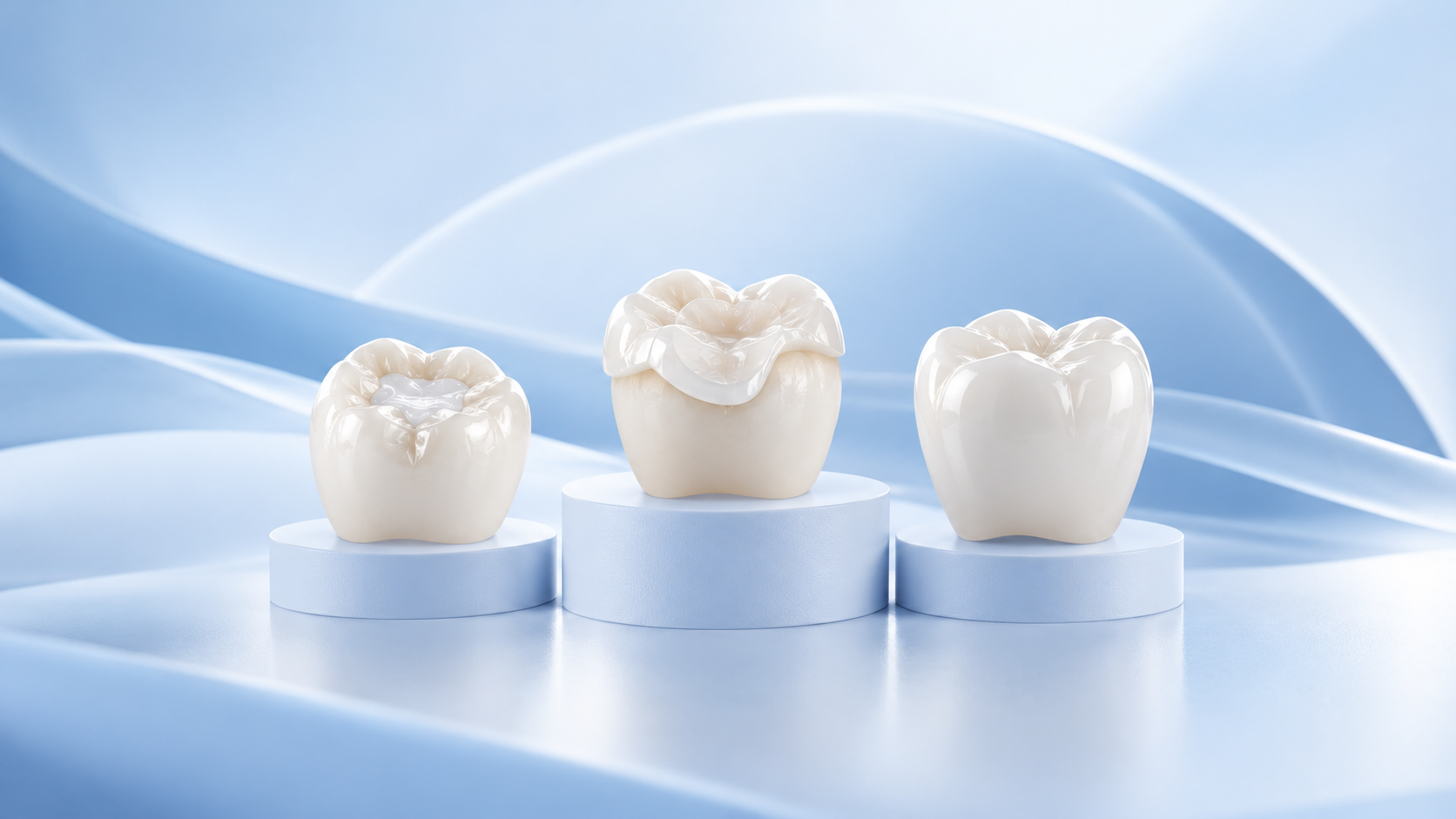
1. Filling - when the damage is limited
A filling is one of the most common ways to restore a tooth affected by decay or a small fracture.
During the procedure, the damaged tooth tissue is removed and the missing part of the tooth is usually rebuilt with a composite material that is shaped directly in the mouth.
When is a filling suitable?
For small and medium-sized cavities.
When enough healthy tooth structure remains.
For small fractures or defects.
When replacing an old filling, provided the remaining tooth walls are strong enough.
Advantages
Preserves as much healthy tooth structure as possible.
Usually completed in a single visit.
Generally the most affordable option.
Can often be adjusted or repaired if certain defects occur.
Disadvantages
It may not be a reliable solution when a large portion of the tooth has been lost.
When a filling is very large, the surrounding tooth walls may become thin and weak. During chewing, these walls are exposed to significant forces and may gradually develop cracks. Over time, this can lead to part of the tooth breaking, even during normal eating.
Important: A large filling does not necessarily mean that the tooth has been restored securely. When the remaining walls are very thin, there is a greater risk of fracture during chewing.
2. Overlay - when the tooth needs additional protection
An overlay is a custom-made restoration designed specifically for the individual tooth, most commonly made from ceramic or composite material.
Unlike a conventional filling, an overlay covers one or more of the tooth’s cusps. In this way, it replaces missing tooth structure while also protecting weakened areas from fracture.
When is an overlay suitable?
For large cavities or extensive old fillings.
When one or more tooth walls are weakened.
When part of the chewing surface has fractured.
For teeth that have undergone root canal treatment.
When a filling would not provide enough strength, but the tooth does not need to be completely covered with a crown.
Advantages
Preserves more natural tooth structure than a traditional crown.
Protects weakened parts of the tooth.
Allows precise restoration of the tooth’s shape and chewing surface.
Ceramic overlays can provide very good aesthetics and wear resistance.
Disadvantages
Higher cost than a conventional filling.
Often requires two visits.
Why can an overlay be a good alternative to a crown?
Because it allows the damaged parts of the tooth to be strengthened and protected without necessarily reducing all of its surfaces.
This makes an overlay particularly valuable when the goal is to preserve as much of the natural tooth as possible.
3. Crown - when the tooth is severely damaged
A dental crown is a custom-made restoration that covers all or almost all of the visible part of the tooth.
It restores the tooth’s shape, function, and appearance. In modern dentistry, crowns are commonly made from zirconia.
When is a crown suitable?
For severely damaged teeth with little healthy tooth structure remaining.
When a reliable restoration cannot be achieved with a filling or an overlay.
When the visible part of the tooth requires extensive reconstruction.
Advantages
Can restore significantly damaged teeth when there is sufficient structure for retention.
Restores shape, contact points, and chewing function.
Can provide a long-lasting solution when properly planned and maintained.
Modern materials can provide very good aesthetic results.
Disadvantages
Usually requires the removal of more tooth structure than a filling or overlay.
Higher cost.
Important: Placing a crown does not make a tooth indestructible. Natural tooth structure remains underneath the crown and still requires proper care.
Filling, overlay or crown - what are the main differences?
| Filling | Overlay | Crown | |
|---|---|---|---|
| Suitable for | Small and medium-sized defects | Larger defects with weakened cusps | Severely damaged teeth |
| Preservation of tooth structure | Very good | Very good | Usually requires more tooth reduction |
| Coverage | Fills the defect | Covers the defect and part of the chewing cusps | Covers almost all or all of the tooth |
| Visits | Usually 1 | Often 1-2 | Often 1-2 |
| Cost | Usually the lowest | Higher | Higher |
Is a crown always the strongest solution?
Not necessarily.
There is a common misconception that the larger the restoration, the better protected the tooth will be.
In reality, the best restoration is the one that provides sufficient strength and function while preserving as much healthy natural tooth structure as possible.
For example, if a tooth has a large filling but still has enough strong remaining walls, an overlay may be a more conservative option than a crown.
On the other hand, when a tooth is severely damaged, placing another large filling may not always be the most reliable solution.
How is the right restoration chosen?
The decision does not depend only on the size of the cavity. During the examination, the dentist evaluates:
How much healthy tooth structure remains.
The thickness and strength of the remaining tooth walls.
Whether the tooth has undergone root canal treatment.
Whether cracks or fractures are present.
The patient’s bite and the forces placed on the tooth during chewing.
Whether the restoration can be reliably bonded or cemented.
This is why two teeth that appear to have similar fillings may require completely different treatment approaches.
Conclusion: preserving the natural tooth is the priority
Modern dentistry aims not only to replace the missing part of a tooth, but also to keep the tooth healthy and functional for as long as possible.
Fillings, overlays, and crowns are not competing treatment methods. Each has its own indications and can be the most appropriate option in a particular clinical situation.
The goal is not to choose the largest or most expensive restoration, but the one that is most suitable for the individual tooth.
If you have a large old filling, a fractured tooth, or you are unsure whether you need a crown, a dental consultation can help assess the condition of the tooth and determine the most appropriate treatment.